


Why Most SaaS Scale-ups Inadvertently Build a ‘Distributed Monolith’ (And How to Fix It)
Your engineering team made the leap. You broke apart the monolith, containerised your services, set up Kubernetes, and launched what you confidently called a microservices architecture. Deployments should be faster. Teams should be independent. Scale should be effortless.
But somehow, everything still moves slowly. A change in one service still requires coordination with three other teams. A production deploy still feels like defusing a bomb. Your cloud bill has doubled, and nobody can quite explain why.
Welcome to the distributed monolith — one of the most common and costly architectural anti-patterns plaguing modern SaaS scale-ups. You have all the operational complexity of microservices and none of the freedom.
This article will explain what a distributed monolith actually is, how SaaS companies accidentally build them, how to diagnose one in your own system, and — most importantly — how to fix it.
Key Industry Statistic
A 2025 CNCF survey found that 42% of organisations are now consolidating microservices back into larger deployable units, driven by debugging complexity, operational overhead, and network latency issues. Meanwhile, Gartner reports that 60% of teams regret adopting microservices for small-to-medium applications.
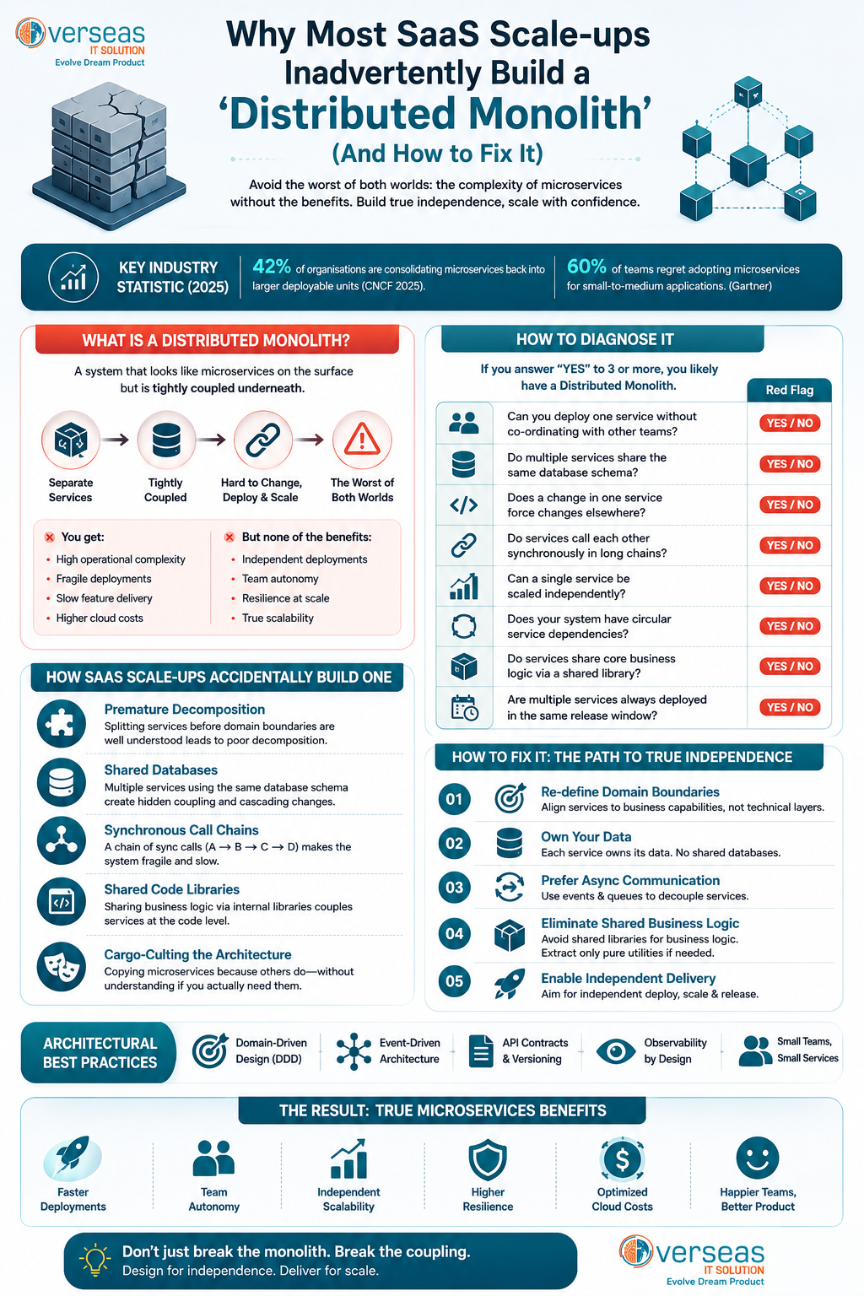
1. What Is a Distributed Monolith?
A distributed monolith is a software system that looks like microservices on the surface — separate services, separate repositories, separate containers — but behaves like a monolith underneath. The services are tightly coupled to one another, meaning they cannot be developed, deployed, or scaled independently.
It is, quite literally, the worst of both worlds:
- The deployment complexity and operational overhead of a distributed system
- The tight coupling, slow releases, and lack of resilience of a monolith
Definition
A distributed monolith is a system that outwardly resembles a microservices architecture but still has a high degree of coupling between its services, negating the advantages a true microservices design offers. This tight coupling occurs when services are overly reliant on one another, reducing flexibility and maintainability while hampering the ability to scale or deploy individual services independently.
Unlike a traditional monolith — which is a single deployable unit and can actually be quite manageable for smaller teams — a distributed monolith adds layers of infrastructure complexity while delivering none of the autonomy that microservices promise.
2. How SaaS Scale-ups Accidentally Build One
The distributed monolith is rarely built on purpose. It is the unintended result of well-meaning architectural decisions made under pressure. Here is how it typically happens in a growing SaaS company:
2.1 Premature Decomposition
The founding engineering team builds a clean monolith. The product gains traction. Leadership reads about Netflix and Uber, and the instruction comes down: "Migrate to microservices." The problem is that Netflix's microservices architecture was built after years of running a validated product with thousands of engineers. Splitting services before your domain boundaries are well understood almost guarantees poor decomposition. As one widely cited engineering principle puts it: premature decomposition creates the worst outcome — a distributed monolith, where services are technically separate but still tightly coupled through shared databases or synchronous chains of API calls.
2.2 Shared Databases
One of the most common culprits. When multiple microservices read from and write to the same database schema, they are not truly independent. A schema change in one area cascades through every service that touches that table. This is the database equivalent of tight coupling, and it is extremely common in companies migrating an existing monolith.
2.3 Synchronous Call Chains
Service A calls Service B. Service B calls Service C. Service C calls Service D. If any one link in that chain goes down, the whole feature fails. This synchronous dependency chain makes the system fragile, introduces latency, and means you effectively cannot deploy any one service independently.
2.4 Shared Code Libraries
Teams extract shared code into internal libraries to avoid duplication. Sensible at first. But when those libraries grow to contain business logic rather than pure utilities, services become coupled at the code level. A change to the shared library requires coordinated releases across every consuming service.
2.5 Cargo-Culting the Architecture
There is a persistent myth in SaaS culture that microservices are what serious engineering teams use. This reasoning skips over the fact that the companies typically cited — Netflix, Amazon, Uber — had already validated their products at scale before microservices became necessary. Following the form without understanding the purpose produces exactly the distributed monolith pattern.
3. How to Diagnose a Distributed Monolith
Use the following diagnostic framework to assess your current architecture. If you answer "yes" to three or more of these questions, you likely have a distributed monolith.
| Diagnostic Question | Red Flag | What It Indicates |
|---|---|---|
| Can you deploy one service without co-ordinating with other teams? | No | Lock-step deployment coupling |
| Do multiple services share the same database schema? | Yes | Database-level tight coupling |
| Does a change in one service force changes elsewhere? | Yes | Cascading domain coupling |
| Do services call each other synchronously in long chains? | Yes | Synchronous call chain fragility |
| Can a single service be scaled independently? | No | Missing deployment independence |
| Does your system have circular service dependencies? | Yes | Circular dependency anti-pattern |
| Do services share core business logic via a shared library? | Yes | Shared codebase coupling |
| Are multiple services always deployed in the same release window? | Yes | Functional monolith in disguise |
4. The Real Cost of a Distributed Monolith
The distributed monolith is not just an architectural inconvenience. It has measurable business consequences for SaaS scale-ups:
4.1 Slowed Feature Velocity
When teams cannot deploy independently, every feature release requires coordination across multiple squads. What should be a one-team, one-day deployment becomes a week-long cross-team exercise. Engineering throughput drops, time-to-market increases, and your competitors move faster.
4.2 Compounding Infrastructure Costs
You are paying the operational overhead of microservices — separate CI/CD pipelines, separate monitoring stacks, separate container registries — but you cannot scale individual services independently because of tight coupling. Amazon Prime Video's famous case study is instructive: their distributed monitoring system was too expensive to run at scale and hit limits at just 5% of expected load. Consolidating back into a single service produced a 90% cost reduction.
4.3 Increased Fragility and Cascading Failures
Synchronous service chains create single points of failure. When Service D is slow, Service C slows, which backs up Service B, which times out for Service A, which presents as a front-end failure. Debugging this kind of cascading failure in a distributed system is significantly harder than debugging the equivalent in a well-structured monolith.
4.4 Engineering Burnout
Distributed systems fail in ways that monoliths do not. Network calls can time out, return stale data, or fail silently. Handling these failure modes correctly requires deep distributed systems expertise. When the team does not have this expertise, debugging becomes painful, on-call becomes exhausting, and senior engineers burn out.
5. Architecture Comparison: Monolith vs Distributed Monolith vs Healthy Microservices
| Aspect | Traditional Monolith | Distributed Monolith | Healthy Microservices |
|---|---|---|---|
| Deployment | Single unit, simple | Separate but coordinated, painful | Fully independent per service |
| Scalability | Scale the whole app | Scale separately but coupling limits it | Scale individual services as needed |
| Team autonomy | Shared ownership | Technically split, practically coupled | True end-to-end team ownership |
| Fault isolation | Single failure domain | Cascading failures across services | Failures isolated to the service |
| Debugging | Straightforward | Complex, distributed tracing needed | Complex but with clear boundaries |
| Infra cost | Low | High with few benefits | Higher but justified by scale |
| Best fit | Early-stage SaaS | Avoid at all costs | Large-scale, multi-team SaaS |
6. How to Fix a Distributed Monolith
If your diagnosis confirms a distributed monolith, there are three viable paths forward depending on your situation. There is no universally correct answer — the right fix depends on your team size, domain complexity, and growth trajectory.
Option A: Consolidate Back into a Modular Monolith
If your team is small (fewer than 25 engineers), your domain is not yet well understood, and microservices are costing more than they're delivering, consolidate. A well-structured modular monolith — with clearly separated modules, clean internal interfaces, and strong coding conventions — is faster to develop in, easier to debug, and cheaper to run.
Real companies making this choice include Shopify, Gusto, and PlayTech's Casino Backend — not because they could not afford microservices, but because they evaluated the trade-offs and chose pragmatism.
Option B: Re-decompose Along Proper Domain Boundaries
If microservices genuinely make sense for your scale and team structure, the fix is to decompose correctly this time. This means:
- Applying Domain-Driven Design (DDD) to identify genuine bounded contexts
- Giving each service its own dedicated database — no shared schemas
- Replacing synchronous call chains with asynchronous event-driven communication
- Establishing a clear API contract between services with versioning
- Organising teams around services, not functions (Conway's Law alignment)
Option C: The Strangler Fig Pattern
For production systems you cannot take offline, the Strangler Fig Pattern allows you to incrementally refactor. You identify the highest-value bounded contexts, extract them one at a time into truly independent services, and route traffic progressively away from the legacy tightly coupled system. This is lower risk than a big-bang rewrite and allows you to validate each extracted service before moving on.
7. Preventing the Distributed Monolith in Future
Whether you are starting fresh or rebuilding, these architectural principles will prevent the distributed monolith from re-emerging:
7.1 Start With a Monolith, Evolve to Services
Validate your product and understand your domain before decomposing. The microservices inflection point is usually later than founders expect. A well-structured monolith is not technical debt — it is the correct architecture for an early-stage SaaS product.
7.2 Database-per-Service is Non-Negotiable
Each service must own its own data. If two services need to read the same data, they should either duplicate the relevant subset or communicate through a well-defined API or event stream. Shared databases are the number one cause of distributed monoliths.
7.3 Prefer Asynchronous Communication
Synchronous service calls create temporal coupling and fragility. Where business logic allows, use an event-driven architecture (Kafka, RabbitMQ, AWS EventBridge) to decouple services in time as well as in deployment. Events allow services to evolve independently and absorb load spikes gracefully.
7.4 Implement Observability Before You Scale
Distributed systems require distributed tracing, structured logging, and service-level alerting before they can be reliably operated. If you cannot see what is happening inside your system, you cannot debug it or improve it. Invest in observability — tools like Datadog, Honeycomb, or OpenTelemetry — before, not after, splitting services.
7.5 Apply Conway's Law Intentionally
Your software architecture will mirror your team structure, whether you design it that way or not. Make that intentional. Assign clear service ownership to long-lived teams. Avoid shared services owned by nobody, and avoid services requiring multiple teams to co-ordinate for every release.
8. Distributed Monolith Prevention Checklist
| # | Action Item | Priority |
|---|---|---|
| 1 | Audit service dependencies and map all synchronous call chains | Critical |
| 2 | Identify any shared database schemas across services | Critical |
| 3 | Map your services to DDD bounded contexts | High |
| 4 | Replace shared DB access with service-owned data and event streams | High |
| 5 | Implement distributed tracing (e.g. OpenTelemetry + Jaeger) | High |
| 6 | Define and enforce API contracts with versioning | Medium |
| 7 | Assign single-team ownership to every service | Medium |
| 8 | Introduce chaos engineering to test fault isolation | Medium |
| 9 | Evaluate whether consolidation to a modular monolith is more pragmatic | Situational |
| 10 | Document architectural decision records (ADRs) for every major change | Ongoing |
9. When Microservices Are Actually Worth It
Microservices are not inherently wrong. They are the right architecture under specific conditions:
- You have large, independent teams where different squads own entirely different parts of the product
- You have specific components under extreme, uneven load that genuinely need independent scaling
- Your domain is well understood and bounded contexts are stable and clearly defined
- You have the DevOps maturity to run distributed tracing, service meshes, and independent CI/CD pipelines
- You have validated the product at scale and are solving a real operational bottleneck, not a hypothetical one
Netflix, Uber, and Amazon are the right reference points — but only once you are operating at their scale and with their team sizes. For the majority of SaaS scale-ups in the Series A to Series C range, a well-structured modular monolith or a small number of genuinely independent services is the correct architecture.
Is Your SaaS Architecture Holding You Back?
OverseasITSolution specialises in software architecture reviews, microservices strategy, and engineering modernisation for SaaS companies. If you suspect a distributed monolith is slowing your team down, we can help you diagnose it and build a pragmatic path forward.
Contact us at: https://overseasitsolution.com/contact
10. Conclusion
The distributed monolith is not a failure of intention — it is a failure of execution under pressure. Growing SaaS companies reach for microservices as a symbol of engineering maturity, and in doing so, often inherit all the complexity of a distributed system with none of the benefits.
The fix is not always more microservices. Sometimes it is better microservices, with proper domain boundaries, database-per-service discipline, and asynchronous communication. Sometimes it is a consolidation back to a well-structured modular monolith.
What matters is making the architectural decision deliberately, with a clear understanding of your team size, domain maturity, and operational capability — rather than following industry trends that were designed for companies operating at a fundamentally different scale.
The most scalable architecture is the one your team can actually reason about, deploy confidently, and operate reliably. Start there.
References & Further Reading
- CNCF Annual Survey 2025 — Microservices Adoption Trends
- Gartner Technology Report: Microservices Regret in SME SaaS (2024)
- Amazon Prime Video Engineering Blog — Scaling Up the Prime Video Audio/Video Monitoring Service (2023)
- MDPI Future Internet: Modular Monolith Architecture in Cloud Environments — A Systematic Literature Review (2025)
- Martin Fowler — Microservices and the First Law of Distributed Objects
- Sam Newman — Building Microservices: Designing Fine-Grained Systems (2nd Ed.)
- vFunction — Distributed Monolith Architecture: What It Is, Why It Happens, and How to Fix It (2025)
Published by OverseasITSolution Engineering Team | https://overseasitsolution.com/blog/distributed-monolith-saas