

Why Do Stripe Webhooks Fail During Traffic Spikes, and How Do You Stop It?
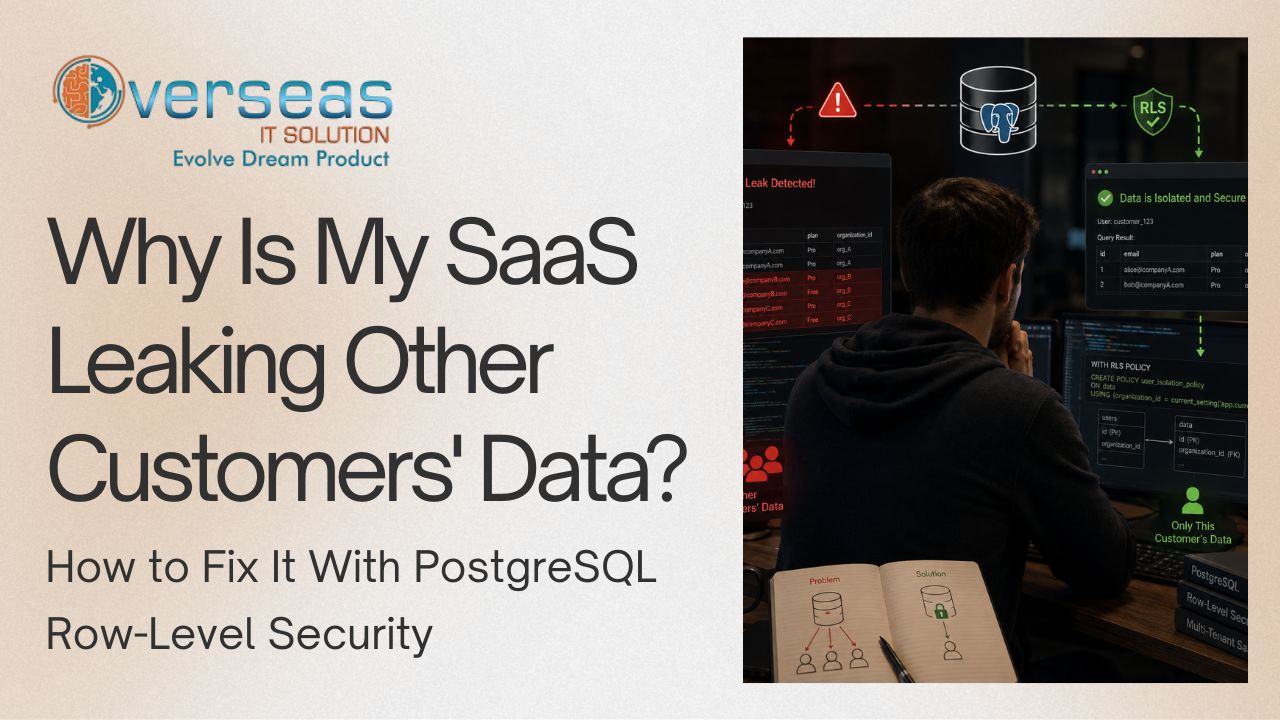
Picture this: a customer emails your support team, confused because their dashboard just showed them a competitor's invoice. No hack, no breach alert, no suspicious login. Just a query that returned rows it should never have touched. This is tenant bleed — and in multi-tenant SaaS applications, it is one of the most common, most preventable, and most reputation-destroying failures a growing engineering team can have.
If you're building a SaaS product on a shared database — which most B2B platforms do, because it's cheaper to operate and easier to scale than provisioning a database per customer — you are one missing WHERE clause away from this happening to you. The good news is that PostgreSQL gives you a built-in, database-level defense against exactly this scenario: Row-Level Security (RLS). This guide walks through what tenant bleed actually is, why relying on application code alone isn't enough, and how to implement RLS correctly, with the testing steps most teams skip.
What Is Tenant Bleed, and Why Does It Happen in Multi-Tenant SaaS?
Tenant bleed is the unauthorized exposure of one customer's (tenant's) data to another tenant within a shared application. It's not always caused by a malicious actor. Most of the time, it's caused by an engineer under deadline pressure who forgot a tenant_id filter, a new hire who copied an old query pattern without realizing it skipped tenant scoping, or a background job that iterates across all rows instead of a single tenant's rows.
The Shared Database Trap
Most SaaS products use a shared-database, shared-schema model: every customer's data lives in the same tables, distinguished only by a tenant_id or organization_id column. This is efficient and cost-effective, but it means every single query in your codebase — every SELECT, every JOIN, every reporting job — has to remember to filter by tenant. There is no structural barrier stopping one tenant's query from touching another tenant's rows. The isolation exists only if every developer, on every line of code, gets it right, every time.
How a Single Missing WHERE Clause Becomes a Data Breach
Consider a simple invoices table shared across all customers. A developer writes a report endpoint that joins invoices with line_items but forgets to add AND tenant_id = current_tenant() to the join condition. In testing, with only one tenant's data in the database, this bug is invisible. In production, with thousands of tenants, it silently returns cross-tenant rows the moment two customers' data happens to share a join key. This is exactly the kind of defect that slips past code review and unit tests, because nothing about the query looks wrong in isolation — it's only wrong in a multi-tenant context.
Why Traditional Access Control Isn't Enough
Most teams try to solve this with application-layer safeguards: an ORM scope that automatically appends tenant_id, a middleware that injects the current tenant into every query builder, or code review checklists. These help, but they all share the same weakness — they depend on every code path remembering to apply them. A new microservice, a one-off admin script, a data migration, or a third-party integration can all bypass the ORM layer entirely and query the database directly. The moment any code path talks to Postgres without going through your tenant-scoping logic, your isolation guarantee is gone.
This is the core architectural problem: application-level tenant scoping is a convention, not a constraint. Conventions get broken under deadline pressure. What SaaS teams actually need is a rule enforced by the database itself, so that even a raw, unscoped query physically cannot return another tenant's rows.
What Is PostgreSQL Row-Level Security (RLS)?
Row-Level Security is a native PostgreSQL feature that lets you attach access-control policies directly to a table. Once enabled, Postgres silently rewrites every query against that table to include your policy's filter condition — regardless of whether the query came from your application's ORM, a raw SQL script, a BI tool, or a careless intern with database credentials. RLS moves tenant isolation from "something developers must remember" to "something the database enforces automatically."
How RLS Works Under the Hood
When RLS is enabled on a table, PostgreSQL checks every SELECT, INSERT, UPDATE, and DELETE against one or more policies you define. A policy is essentially a boolean expression — commonly referencing a session variable that identifies the current tenant — that must evaluate to true for a row to be visible or modifiable. If no policy matches, the row simply does not exist as far as that query is concerned. Critically, this happens at the query-planning level inside Postgres itself, not in your application code, so it cannot be accidentally skipped.
RLS vs. Application-Level Filtering
Application-level filtering asks: "did the developer remember to add this condition?" RLS asks: "can this query even see rows that violate the policy?" — and the answer is no, structurally. RLS doesn't replace good application code; it's a safety net underneath it. Even a compromised connection string, a debugging session, or a poorly reviewed migration script inherits the same protection, because the restriction lives in the database, not in a library your team maintains.
Step-by-Step: Implementing Row-Level Security for Tenant Isolation
Step 1 — Enable RLS on Your Tables
Start by enabling RLS on every table that stores tenant-specific data. This is a one-line command per table:
ALTER TABLE invoices ENABLE ROW LEVEL SECURITY;
At this point, by default, no rows are visible to anyone until you define a policy — a good default, since it fails closed rather than open.
Step 2 — Create Tenant Isolation Policies
Next, define a policy that only allows access to rows matching the current tenant's ID. Most teams store the active tenant in a Postgres session variable set at the start of each request:
CREATE POLICY tenant_isolation_policy ON invoices
USING (tenant_id = current_setting('app.current_tenant')::uuid);
This single policy now governs every SELECT, UPDATE, and DELETE against the invoices table. If you also need to restrict inserts, add a WITH CHECK clause with the same condition so a session can't insert rows belonging to a different tenant.
Step 3 — Set the Tenant Context Per Session
RLS policies need to know which tenant is making the request. This is typically done once per database connection or transaction, right after your application authenticates the user:
SET app.current_tenant = '3fa85f64-5717-4562-b3fc-2c963f66afa6';
This should be wired into your connection pooling and request middleware so it happens automatically and consistently — never left to individual developers to remember on a per-query basis.
Step 4 — Test for Leaks Before You Ship
RLS is only as good as your testing. Before rolling this out to production, run an explicit cross-tenant test: authenticate as Tenant A, attempt to query or reference a row known to belong to Tenant B by its primary key, and confirm Postgres returns zero rows — not an error, not a redacted row, but genuinely nothing. Automate this as a regression test that runs on every deploy, not a one-time manual check.
Common Mistakes That Still Cause Tenant Bleed With RLS Enabled
- Forgetting to enable RLS on newly created tables — RLS must be turned on per table, and it's easy to miss on a table added six months after the original migration.
- Using a superuser or the table owner's role for application connections — RLS policies are bypassed by default for table owners and superuser roles, so your app's database user must be a regular, non-owner role.
- Relying on the application to set the tenant variable but never validating it — if
app.current_tenantcan be left unset, some Postgres configurations will error out, but others may fall back in ways you don't expect, so always validate the session variable is present before running queries. - Skipping WITH CHECK clauses — a USING clause alone controls what you can read, but without WITH CHECK, a session can still insert or update rows into another tenant's records.
- Assuming RLS covers background jobs and admin tools automatically — cron jobs, data exports, and internal admin dashboards still need to set the correct tenant context, or be explicitly designed to operate cross-tenant with a separate, audited role.
Beyond RLS: Defense-in-Depth for Multi-Tenant SaaS
RLS is a strong foundation, but mature SaaS teams layer it with additional safeguards: audit logging on sensitive tables to detect anomalous cross-tenant access attempts, automated tests that run as part of CI/CD rather than manual QA, and periodic access reviews for any role that has BYPASSRLS privileges. For SaaS products handling regulated data — healthcare, finance, or enterprise HR — many teams also add encryption at the column level for the most sensitive fields, so that even a successful tenant-bleed event exposes ciphertext, not usable data. RLS reduces the likelihood of a leak dramatically; defense-in-depth reduces the blast radius if one still slips through.
Why This Matters for SaaS Companies, Not Just Engineers
A tenant-bleed incident is rarely just a bug ticket. For B2B SaaS companies, it's a trust event that can trigger customer churn, break enterprise security reviews, and in regulated industries, create real compliance exposure under frameworks like SOC 2 or HIPAA. Enterprise buyers increasingly ask specifically how data isolation is enforced during security questionnaires, and "row-level security enforced at the database layer" is a materially stronger answer than "our ORM handles that." Investing in RLS early isn't just a security fix — it's a sales enablement asset for any SaaS company trying to close enterprise deals.
Frequently Asked Questions
| Does PostgreSQL Row-Level Security slow down query performance? | In most well-indexed schemas, the performance impact is minimal because Postgres folds the policy condition into the query plan, similar to an additional WHERE clause. Make sure your tenant_id column is indexed (ideally as part of a composite index with other frequently filtered columns), and benchmark query plans with EXPLAIN ANALYZE before and after enabling RLS on high-traffic tables. |
| Is Row-Level Security enough on its own, or do I still need application-level tenant checks? | Keep your application-level checks. RLS is a safety net, not a replacement for good application design. Defense-in-depth means a bug in your application code is caught by RLS, and a misconfiguration in RLS is still constrained by sane application logic — neither layer should be your only line of defense. |
| Does RLS work with connection pooling tools like PgBouncer? | It can, but it requires care. Session-level variables set with SET don't always persist correctly across pooled connections in transaction-pooling mode. Many teams instead pass the tenant ID as a parameter within each query's policy check, or use PgBouncer's session pooling mode for RLS-protected connections to avoid tenant context leaking between reused connections. |
| Can superusers or database admins bypass Row-Level Security? | Yes, by default, table owners and roles with the BYPASSRLS attribute bypass RLS policies entirely. This is why your application's database user should be a dedicated, least-privilege role that does not own the tables and does not have BYPASSRLS — otherwise your policies provide a false sense of security. |
| How do I migrate an existing multi-tenant SaaS app to use RLS without downtime? | Roll it out incrementally: enable RLS on one table at a time, starting with your least-critical, lowest-traffic table as a proof of concept. Run it in parallel with your existing application-level checks for a few weeks, monitor for unexpected access denials in your logs, and only remove the legacy checks once you've confirmed RLS policies are working correctly across all query paths, including background jobs and admin tools. |
| Does Row-Level Security work with NoSQL or non-relational databases? | RLS as described here is specific to PostgreSQL (and similar SQL databases with row-security features). NoSQL databases like MongoDB don't have a direct equivalent; tenant isolation there typically has to be enforced through application logic, database-per-tenant architectures, or field-level access control provided by the specific database vendor. |
Worried Your SaaS Architecture Has a Tenant Isolation Gap?
Our engineering team helps SaaS companies audit multi-tenant architecture, implement PostgreSQL Row-Level Security correctly, and close the security gaps enterprise buyers ask about. Talk to our team at overseasitsolution.com and get a free architecture review before your next enterprise security questionnaire.