

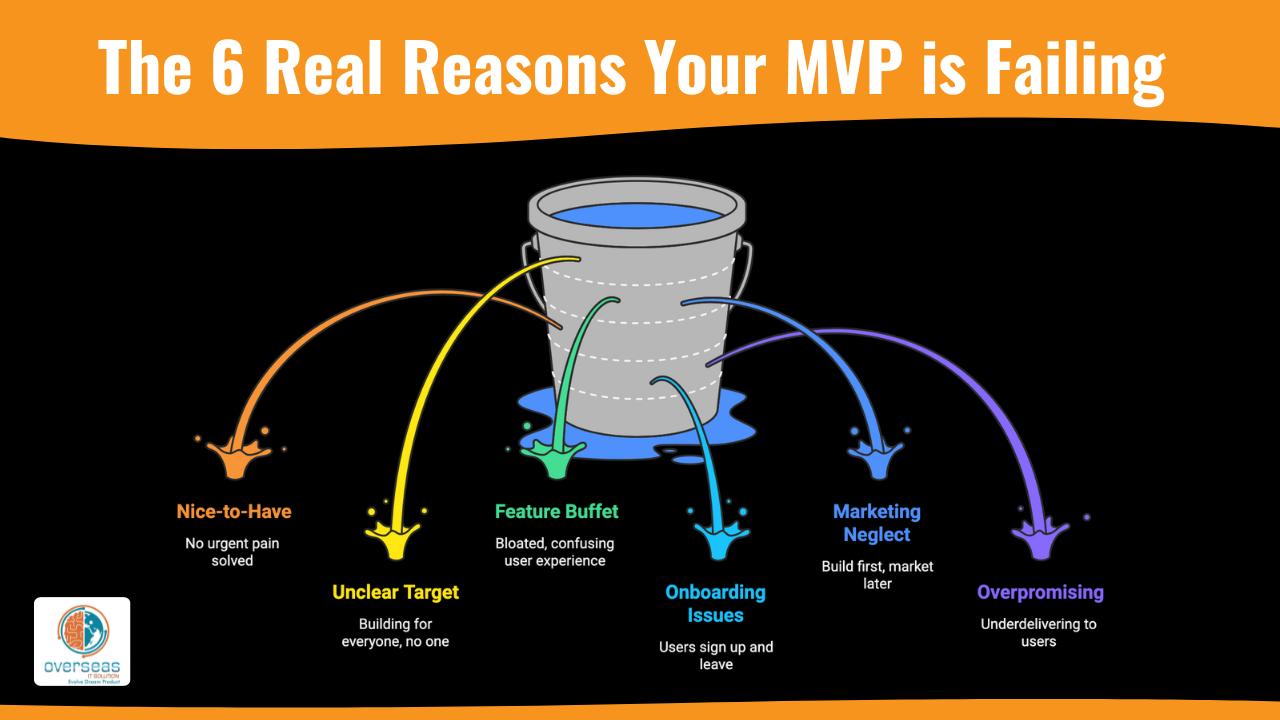
You had a brilliant idea. You spent months building your Minimum Viable Product. You launched. And then... crickets. Zero signups, no traction, and the demoralizing feeling that the world just doesn't care. Even if you got a handful of signups, nobody is actually using the product. You start to spiral, questioning the features, the pricing, the design — everything feels broken, but you don't know where to start.
Rob Walling, who has founded multiple SaaS companies, written five books on startups, and has seen thousands of MVPs launch, has identified the real problems that are often hiding in plain sight. He has pinpointed six specific, non-obvious reasons why most MVPs fail. This guide will walk you through each one to help you diagnose what's broken and determine your next steps.
The 6 Real Reasons Your MVP is Failing
1. You're Solving a "Nice-to-Have" Problem
This is the big one — the most common reason a promising MVP fizzles out. You've built something people acknowledge is clever, but it doesn't solve a burning, urgent pain.
The Symptoms
When you demo your product, potential users say it's "nice" or "interesting," but they show no urgency to buy. Conversations often end with a "polite nod" and no commitment. They acknowledge the problem exists, but they don't feel a pressing need to solve it right now.
The Root Cause
Founders fall into this trap because we get attached to our solution instead of obsessing over the customer's pain. We create a "vitamin" — something that's good to have — instead of an "aspirin," which solves an immediate, painful headache.
Key Insight: The reality is founders fall in love with their idea instead of solving a problem.
The Prescription
Go back to customer interviews and validate purchase intent, not just the problem. As a quick test, Walling suggests asking a potential customer, "Would you pay X for this today if it worked perfectly?" Even if only half of those who say yes actually convert, you start building real data on their willingness to pay.
2. You Don't Know Exactly Who It's For
Without a clear target, you're building for everyone and no one — and your feedback will pull you in a dozen different directions at once.
The Symptoms
You're seeing random signups from completely different industries. Your messaging is generic and unfocused. You get conflicting user feedback from too many disparate voices — twenty different feature requests from twenty different types of users, leaving you with no clear path forward.
The Prescription
Define and commit to a highly specific Ideal Customer Profile (ICP). Contrast a generic approach with a powerfully specific one Walling uses as an example: "marketing ops managers at 20 to 100 person B2B SaaS companies using HubSpot who need accurate attribution."
Pro Tip: You don't need a perfect ICP from day one. Start with 3–5 Early Customer Profiles (ECPs) and commit to one or two focused profiles for 60–90 days to clarify your product roadmap and messaging.
3. Your Product is a Buffet with No Signature Dish
This is perhaps the most classic trap for product-focused founders. We feel the urge to add "just one more feature" to prove our value, but in doing so, we create a bloated, confusing experience.
The Symptoms
You find yourself constantly saying, "I'm still not ready to launch." Early users who do get access complain that the product is "too complicated" and they don't know where to start. Your product has breadth, but no clear, compelling starting point.
The Root Cause
The entire purpose of an MVP is to get a user to their first "aha moment" in minutes. If your product is too broad, that moment gets lost in a sea of features. The counter-intuitive fix is to be ruthless about cutting features to clarify the single, most compelling user path.
The Prescription
For an early MVP, aim for an activation rate — the percentage of users who go from sign-up to first success — of 35% to 50%. By the time Walling's last startup hit product-market fit, their activation rate exceeded 70%. That benchmark shows what's possible when you nail the user path.
4. Your Onboarding Kills All Momentum
Your onboarding can be a silent killer, and you might not even realize it. We get so close to our own products that we forget what it feels like for a user to see a completely blank screen for the first time.
The Symptoms
Users sign up, poke around for a few minutes, and then disappear forever. Your analytics show a sharp drop in usage after day one. You either get support tickets from confused users or, more likely, you hear nothing at all as they quietly churn out.
The Prescription
Improving onboarding is critical for turning signups into active users. Here are actionable steps you can take:
- Replace blank states: Greet new users with sample data, pre-filled examples, or helpful templates instead of an empty dashboard.
- Add guided checklists: Use short, simple checklists to guide users through the key actions they need to take.
- Offer "done for you" onboarding: For your first 10–20 customers, provide a hands-on service to get them set up.
- Watch user sessions: Use a tool like Fullstory to record and watch what new users are actually doing. It can be painful, but it's the fastest way to spot where they hesitate, backtrack, or leave.
5. You Fell into the "Build First, Market Later" Trap
This is the curse of the technical founder. You've mastered the art of building but have forgotten that a great product nobody knows about is a business failure.
The Symptoms
You launch to crickets. You have barely any traffic, a few signups from a post on Product Hunt, and no meaningful feedback because no one is using the app. You've posted on social media, but you have no real users.
The Root Cause
You believed that shipping the product was the finish line, when it was actually the starting line for marketing and distribution. Walling offers a sharp dose of reality on this point:
"Posting on social media is not marketing. Audience building is not marketing if you're building a SaaS."
The Prescription
Instead of random acts of marketing, pick one or two proven B2B SaaS marketing approaches and run dedicated experiments. These include cold outreach, SEO test pages, content marketing, integration marketing, community content, or partnerships. Crucially, Walling distinguishes between an audience and a network — if you've built a network of peers, you can reach out and ask for promotion, joint ventures, or affiliate deals to get real traffic.
6. You Overpromised and Underdelivered
Nothing kills momentum faster than a user feeling misled. This is when you get those gut-punch support tickets and refund requests that make you question everything.
The Symptoms
Users feel disappointed, saying "it doesn't do what I expected." You're getting bad reviews and a high number of refund requests. Your post-launch experience feels demoralizing because you're constantly defending what your product doesn't do.
The Root Cause
Your marketing copy and sales pitches promise a magical solution that the MVP can't yet provide. As Walling notes, this is especially easy to do "in the age of AI where we can say 'Hey we're going to do all this stuff for you'... but when you sit down to try to get AI to do it the results actually aren't that good."
The Prescription
The fix isn't to stop marketing, but to align it with the reality of your product. Take an honest look at your homepage and copy. Tighten your positioning. Frame the MVP honestly as a "beta" or "early access" version to set realistic expectations. Ensure your messaging focuses on the one painful problem your app solves well today.
Conclusion
Building a successful MVP isn't about achieving a single, perfect launch. It's about a continuous process of focused iteration, listening intently to the right customer feedback, and committing to solving one painful problem exceptionally well. Failure isn't the end — it's data. By diagnosing the true reason your MVP is struggling, you can stop guessing and start making the targeted changes that lead to real traction.
Reflect on this: Which of these six signs is your MVP showing right now, and what is the one change you can make this week to fix it?
Fix Your SaaS MVP Before You Waste More Time
Your MVP doesn't need more features. It needs clarity, validation, and the right execution.
Talk to our SaaS MVP experts and get:
- Honest MVP audit
- Feature prioritization roadmap
- ICP & validation guidance
- Faster path to product-market fit