

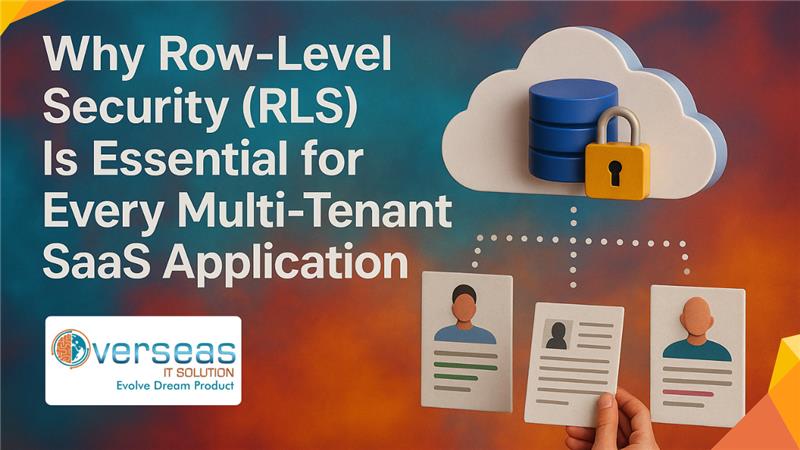
Row-Level Security (RLS) is a critical database-level feature that ensures strict data isolation in multi-tenant SaaS applications. In a world where a single data leak can destroy customer trust and trigger compliance failures, RLS provides an automated, reliable safety net directly at the database layer. This article explains what RLS is, why traditional approaches fall short, and why every SaaS platform should implement it from day one.
When you're building a multi-tenant SaaS platform, the biggest responsibility is not just performance, scalability, or UI design — it's data isolation. One mistake in your data access logic can expose customer information to the wrong user. And in SaaS, a single data leak can cost you customers, credibility, and compliance.
What Is Row-Level Security (RLS)?
Row-Level Security is a database-level feature that restricts which rows a user can access based on predefined policies. Instead of relying only on backend filters or API validations, the database itself decides:
- What rows a user is allowed to read
- What rows a user is allowed to write or update
This makes your data protection far more reliable and consistent across your entire platform.
Why Traditional Approaches Fail in Multi-Tenant SaaS
Many early-stage SaaS companies use techniques like:
- Separate tables for each client
- Role-based access checks at the API layer
- Filtering tenant data using tenant_id in queries
These approaches work initially, but they all share one dangerous flaw:
Why RLS Is the Most Reliable Solution
Row-Level Security adds a strong safety net directly at the database level. Here is why it stands apart from every other approach:
1. Security at the Source
Even if your API allows a user through by mistake, RLS will stop unauthorized access. The database enforces the rule — not the developer.
2. Eliminates Human Error
A missed WHERE tenant_id = ... clause can instantly leak data. With RLS, the database automatically filters data for the correct tenant, regardless of what the application layer does.
3. Perfect for Multi-Tenant Architecture
Every tenant should only access their own rows. RLS ensures strict isolation without rewriting your entire backend logic.
4. Regulatory Compliance
If you're working with industries like healthcare, finance, or enterprise, RLS helps you meet data protection standards — including GDPR, HIPAA, and SOC 2 — effortlessly.
How RLS Works (Simple Explanation)
Imagine your database has millions of records from multiple customers. When User A sends a request, the database checks:
- Who is the user?
- What policy is assigned to them?
- Are they allowed to view these rows?
If not, the database blocks the request — even if your API tries to fetch the data.
With RLS vs Without RLS
| Without RLS | With RLS |
|---|---|
| User A may accidentally see User B's data | Database blocks unauthorized access automatically |
| Developers need to manually apply filters everywhere | Zero dependency on developer-written filters |
| One mistake can cause a data breach | Strong tenant isolation at all times |
| Scaling increases the risk of human error | Consistent protection across the entire system |
Why Your SaaS Needs RLS from Day One
Startups often skip RLS during the initial MVP phase. But as soon as you start onboarding real tenants, everything compounds rapidly:
- Data grows
- Queries grow
- Teams grow
- Complexity grows
- Risk grows
Final Thoughts
Row-Level Security is not just another database feature — it's a foundational requirement for any serious multi-tenant SaaS application. It ensures that every tenant sees only their own data, even if other layers of your system fail.
If you want your SaaS to be trustworthy, secure, compliant, and enterprise-ready, RLS should be part of your architecture from day one.
If you need help implementing RLS or building a secure multi-tenant SaaS platform, feel free to reach out to Overseas IT Solution — we specialize in scalable and secure SaaS development.