

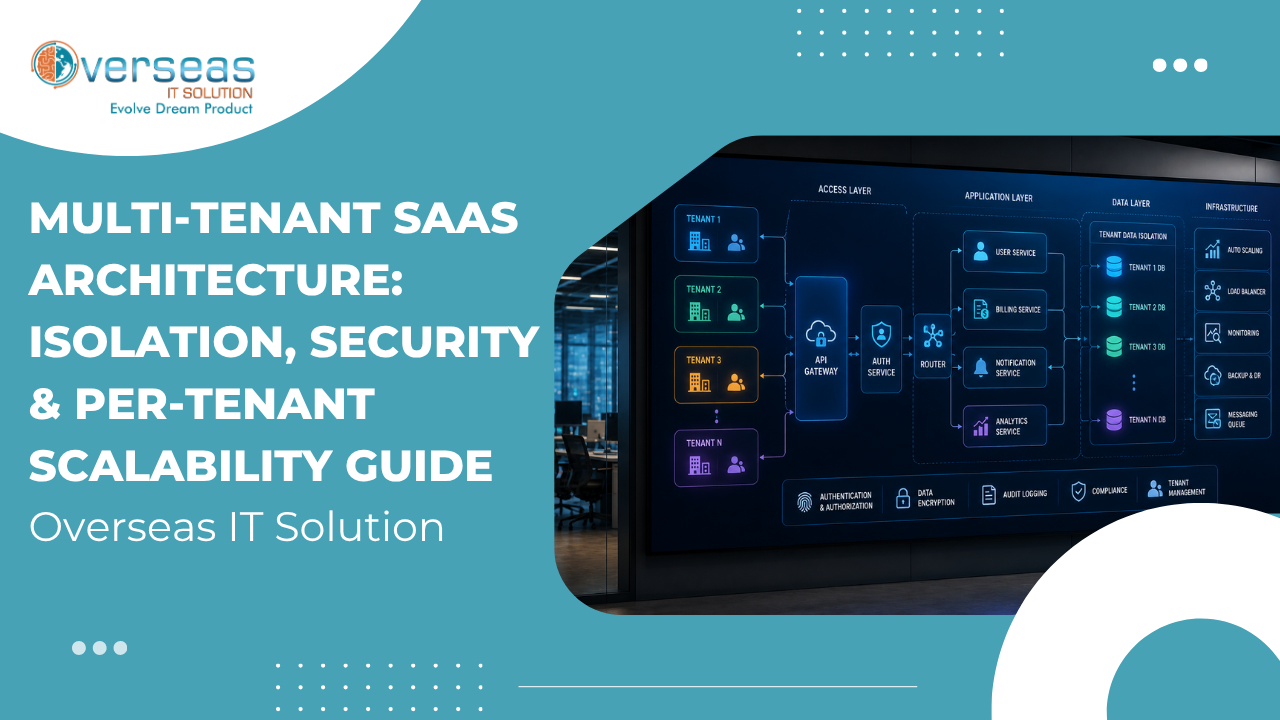
Multi-tenancy is the foundational design decision of every SaaS platform — and getting it wrong is extraordinarily expensive to fix post-launch. The choice of tenancy model affects your database design, security model, deployment strategy, compliance posture, and per-tenant cost structure. This article provides a systems-level breakdown of every major approach, with the trade-offs that matter in real production environments.
Scope of This Article
This guide is designed for architects and CTOs building B2B SaaS platforms, white-label software products, and enterprise applications serving multiple independent customers from shared infrastructure.
The Three Multi-Tenancy Models: A Rigorous Comparison
There are three canonical approaches to multi-tenancy, each representing a different point on the isolation-vs-cost spectrum. The right choice depends on your target customer size, compliance requirements, customization demands, and unit economics.
| Model | Isolation | Cost / Tenant | Customization | Best For |
|---|---|---|---|---|
| Database per Tenant | Maximum | High | Full schema | Enterprise, regulated |
| Schema per Tenant | High | Medium | Per-schema extensions | Mid-market B2B SaaS |
| Shared Schema (RLS) | Medium | Very Low | Config-based only | SMB SaaS, high-volume |
Database-per-Tenant: Maximum Isolation
Each tenant gets a dedicated database instance. Data is physically separated, simplifying compliance (GDPR, HIPAA, SOC 2 data residency requirements are trivially satisfied). Schema migrations can be applied per-tenant without affecting others. The downside is cost — each tenant requires dedicated database resources even when idle, making this model viable only when tenants pay enough to justify the infrastructure.
Shared Schema with Row-Level Security: The Cost-Efficient Model
All tenants share the same tables, with a tenant_id column on every row. PostgreSQL's Row-Level Security (RLS) feature enforces that queries can only see rows belonging to the authenticated tenant. This model scales to thousands of tenants on shared infrastructure but requires extreme discipline — any query bypassing RLS policies is a critical security vulnerability.
The PostgreSQL implementation requires setting a session variable at connection time and creating RLS policies on every table:
SET app.current_tenant = 'tenant_uuid';Connection pooling must use separate pools per tenant. PgBouncer in transaction mode does not preserve session variables — this is a common mistake that causes security incidents.
Tenant Onboarding as an Engineering Problem
Manual tenant provisioning doesn't scale. A well-designed SaaS platform should provision a new tenant — database schema, S3 buckets, CDN configurations, notification preferences, initial seed data — in under 30 seconds, fully automated.
Tenant Provisioning Automation Checklist
- Database schema creation or row-level policy application
- S3 bucket or storage namespace provisioning
- CDN configuration and custom domain setup
- Default configuration seeding (roles, permissions, settings)
- Billing plan association and usage metering setup
- Event emission to notify downstream services (analytics, support tools)
Per-Tenant Customization Without Code Forking
Every B2B SaaS platform eventually faces enterprise customer demands for customization. The wrong approach is maintaining separate code branches per customer. The right approach is building a feature flag and configuration system that allows:
- Per-tenant feature toggling with LaunchDarkly or Unleash
- White-labeling with custom logos, color schemes, and domain names
- Workflow customization via metadata-driven schema extensions
- Per-tenant integration configuration (which third-party integrations are enabled)
Critical Security Rule
Never use tenant_id from user input (URL parameters, request bodies) for data scoping. Always derive tenant_id from the authenticated JWT claim. Trusting user-supplied tenant IDs is a BOLA/IDOR vulnerability — listed in the OWASP API Security Top 10.
Usage Metering and SaaS Billing Architecture
Usage-based pricing is the dominant SaaS billing model in 2025. Implementing it requires a metering pipeline that captures every billable event (API calls, storage bytes, active users, processed records), aggregates them efficiently, and feeds a billing system.
Billing Architecture Components
| Component | Technology | Purpose |
|---|---|---|
| Metering Ingestion | Apache Kafka | Durable event capture, no lost events |
| Aggregation | Apache Flink / Spark | Real-time usage aggregation |
| Metering Store | TimescaleDB | Time-series usage data, audit trail |
| Billing Engine | Stripe / Chargebee | Invoice generation, plan enforcement |
| Usage Dashboard | Redis + API | Near-real-time usage visibility for tenants |
Work With Us
Overseas IT Solution has delivered multi-tenant SaaS products across healthcare, ERP, and B2B verticals. We architect for isolation, compliance, and scale from day one.
Visit overseasitsolution.com
© 2026 Overseas IT Solution · overseasitsolution.com · Ahmedabad, Gujarat, India