

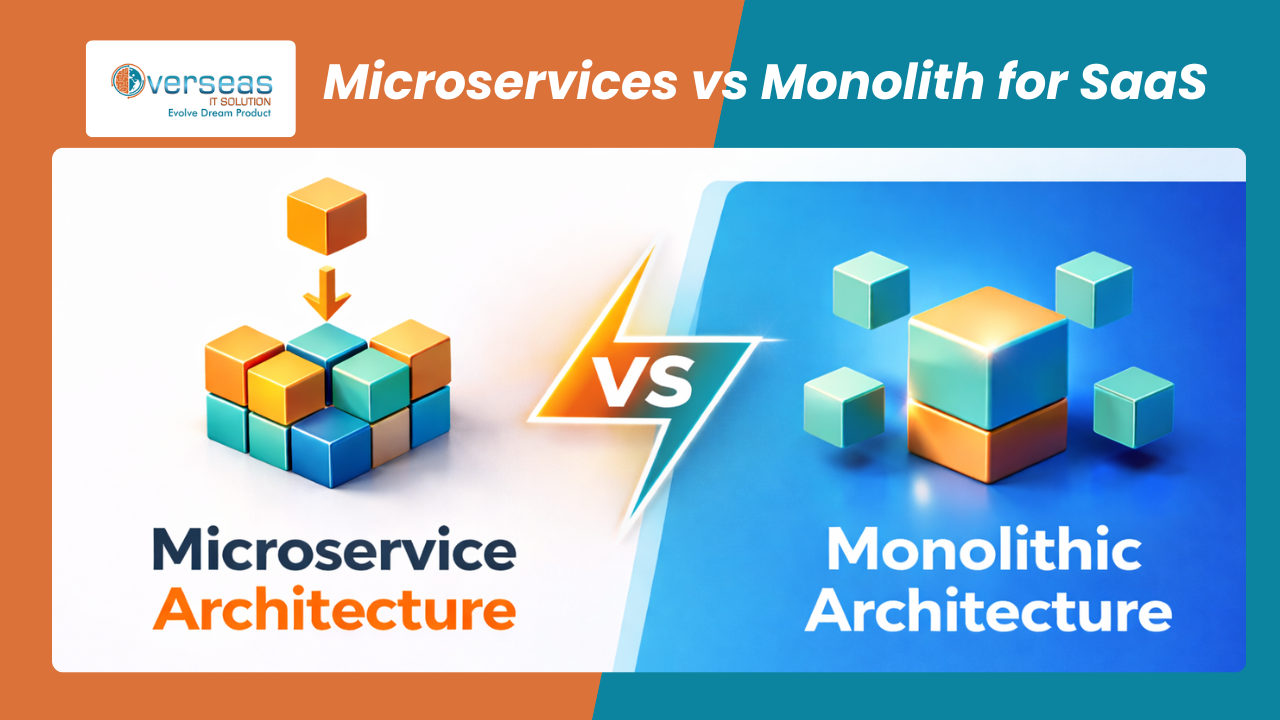
By Overseas IT Solutions Engineering Team | 12 min read | SaaS Architecture, Engineering Strategy
Microservices vs Monolith for SaaS: The Decision Framework Based on Team Size & Budget
Every SaaS founder hits the moment: your team is growing, your codebase is getting messier, and someone suggests moving to microservices. Or the opposite — you're drowning in microservice complexity and someone whispers, "maybe we should consolidate back." The internet is full of opinions. Almost none of them give you a concrete framework. They all say "it depends" and stop right there. This article is different. We give you hard numbers, real budget thresholds, and a decision matrix you can use today based on your actual team size, monthly budget, and growth stage.
The $100K Architecture Mistake
Architecture decisions don't just affect your code — they affect your burn rate, hiring plan, and speed to market. Getting this wrong can cost $50,000 to $500,000 in unnecessary infrastructure, DevOps overhead, and engineering rework. This guide is designed to help you make the right call before that mistake happens.
Part 1: Understanding the Architecture Spectrum
Before the decision framework, let's establish practical definitions — not textbook ones.
The Monolith
A monolith is a single deployable unit where all application logic lives together — authentication, payments, notifications, analytics — in one codebase and one deployment pipeline.
- One codebase, one deployment
- Shared database across all features
- Changes to any part require redeploying the whole application
- Lower infrastructure complexity, significantly lower operating cost
The Microservices Architecture
Microservices split your application into independent services, each responsible for one domain — and each deployed, scaled, and maintained independently.
- Multiple codebases, multiple deployment pipelines
- Each service owns its own database (ideally)
- Services communicate via APIs, REST, or message queues (Kafka, RabbitMQ)
- High operational complexity and infrastructure cost — but strong scalability at scale
The Modular Monolith: The Overlooked Middle Ground
This is the architecture most SaaS companies should start with — and most articles fail to mention. A modular monolith is a single deployable unit with strong internal module boundaries that mirror microservice thinking.
- Single deployment — full monolith simplicity
- Enforced module separation — microservice readiness built in
- Can be incrementally extracted into services as you scale
- The architectural choice behind Netflix, Shopify, and Stack Overflow in their growth phases
Part 2: The Core Decision Framework — Team Size x Budget x Stage
Here is the framework most SaaS architecture consultants charge $10,000 to build for you. We're sharing it because architecture alignment is the foundation of every engagement we run.
Architecture Decision Matrix
| Team Size | Monthly Revenue | Recommended Architecture | Infra Cost/Month | Risk |
|---|---|---|---|---|
| 1–3 developers | $0–$10K | Monolith | $50–$300 | Low |
| 3–8 developers | $10K–$100K | Modular Monolith | $200–$800 | Medium |
| 8–20 developers | $100K–$500K | Hybrid (Selective Services) | $800–$3K | Medium-High |
| 20+ developers | $500K+ | Full Microservices | $3K–$20K+ | High |
This matrix is built on three core realities that most articles ignore:
- Microservices require dedicated DevOps/SRE capacity — typically 1 SRE engineer per 5–8 microservices in production.
- Service mesh, observability tooling, and API gateway infrastructure adds $3,000–$15,000 per month before your first line of product code.
- The cognitive overhead of distributed systems slows feature velocity by 30–60% for engineering teams under 15 people.
Part 3: The $100K Architecture Decision — Full Cost Breakdown
Infrastructure cost is only the visible tip of the iceberg. Here is the full total cost of ownership comparison across architectures.
Total Cost of Ownership: Monolith vs Modular Monolith vs Microservices
| Cost Category | Monolith | Modular Monolith | Microservices |
|---|---|---|---|
| Infrastructure/month | $50–$300 | $200–$800 | $3K–$20K+ |
| DevOps Setup Time | 1–2 days | 1–2 weeks | 4–12 weeks |
| Team Required | 1–3 engineers | 3–8 engineers | 10–25+ engineers |
| Deployment Time | Minutes | 5–15 minutes | 30–90 min (CI/CD) |
| Observability Cost | $0–$50/month | $50–$200/month | $500–$5K+/month |
| Hidden Annual Cost | $0–$5K | $5K–$20K | $50K–$300K+ |
The Hidden Cost Nobody Talks About
Microservices' biggest cost is not your AWS or GCP bill — it is engineering time.
A 10-person team spending 40% of sprint capacity on infrastructure (CI/CD pipelines, distributed tracing, service discovery, circuit breakers) instead of product features loses $200K–$400K per year in opportunity cost.
- Modular monolith at 10 engineers: approximately 5–10% infrastructure overhead.
- Full microservices at 10 engineers: approximately 35–50% infrastructure overhead. That delta is where startups go to die.
Part 4: The Offshore Microservices Advantage
Here is an angle that no architecture blog discusses: offshore distributed teams are structurally better suited for microservices than small, co-located in-house teams. Why? Because the defining properties of microservices — independent deployments, clear API contracts, service ownership, asynchronous communication — directly mirror how well-run offshore teams operate.
How Offshore Team Structure Aligns with Microservices
- Independent service ownership maps naturally to dedicated offshore pods (3–5 engineers per service)
- Clear API contracts enforce the documentation and interface-driven development offshore teams already practice
- Asynchronous communication matches timezone-offset workflows naturally — the constraint becomes a feature
- Independent CI/CD pipelines allow each team to deploy and iterate without creating bottlenecks for others
The Structural Advantage: Distributed Architecture = Distributed Teams
A 15-person offshore team at Overseas IT Solutions can manage 8–12 microservices effectively, because our pods are built around service ownership from Day 1. The same 15-person in-house team in San Francisco, paid 3x more, struggles with coordination overhead that erodes the architectural benefit.
Offshore microservices delivery can cut your total architecture operating cost by 40–60%, without any reduction in engineering quality.
Part 5: The Hybrid Strategy — Modular Monolith to Selective Service Extraction
The smartest SaaS companies do not start with microservices. They start with a well-structured monolith and extract services surgically — only when the pain is real, measurable, and specific. Here is the incremental extraction roadmap we recommend to every early-stage SaaS client:
Phase 1: Build a Modular Monolith (0–$100K MRR / 1–8 Developers)
- Design clear module boundaries from Day 1: Auth, Billing, Notifications, Core Product
- Use internal APIs between modules — never direct cross-module database access
- Single deployment, single database — maximum feature velocity
- Goal: ship features fast, validate product-market fit, keep burn low
Phase 2: Extract High-Pain Services ($100K–$500K MRR / 8–20 Developers)
- Identify the 1–2 services causing the most deployment friction or independent scaling need
- Common first extractions: Notifications, Background Jobs, File Processing, or Search
- Keep the monolith as your core — extract only what has clear, proven need
- Add observability tooling (Datadog, New Relic, Grafana) BEFORE extracting any service
Phase 3: Full Domain Decomposition ($500K+ MRR / 20+ Developers)
- Decompose by business domain, not by technical layer
- Invest in service mesh (Istio, Linkerd) and API gateway infrastructure
- Establish per-service SLOs, runbooks, and dedicated service owner teams
- Budget $15K–$50K per month in infrastructure — forecast it into your Series A financial model
Part 6: Real Failed Migrations — What Actually Happened
Theory is cheap. Here is what happened when real companies made these decisions wrong.
Case Study 1: The Startup That Went Microservices Too Early
The Premature Microservice Failure
Company: Series A B2B SaaS — $2.5M raised (name withheld)
Team: 8 engineers
Architecture Decision: Greenfield microservices from Day 1 — 14 independent services
Result: Six months in — 40% of engineering sprint capacity consumed by infrastructure management. Only 3 of 14 services were actually used in production. Burned $380K before the founder made the painful decision to migrate back to a modular monolith.
Lesson: Microservices complexity is manageable with 20+ engineers. With 8 engineers, it is a compounding tax on feature velocity that gets worse every sprint.
Case Study 2: The Company That Stayed Monolithic Too Long
The Late Migration Tax
Company: SaaS analytics platform — bootstrapped, $800K ARR
Team: 22 engineers — grew from 5 without architectural refactoring at key milestones
Problem: A single production deploy took 47 minutes. One bad merge blocked all 22 engineers. The company suffered 3–4 full outages per month affecting all customers simultaneously — from a single point of failure.
Migration Cost: $220,000 and 9 months to extract 6 core services. Revenue growth stalled during the migration window. Two senior engineers left during the process.
Lesson: The right time to begin extracting services is at 8–12 engineers and $100K MRR — not when you are already in production pain.
Case Study 3: The Offshore Team That Got It Right
The Modular Monolith Win
Company: PropTech SaaS startup — VC-backed, $1.2M seed
Team: 10-engineer offshore team managed through Overseas IT Solutions
Decision: Modular monolith for 18 months, then surgical extraction of Notifications and Document Processing as the first two independent services.
Result: Shipped product 4 months faster than their closest competitor. Infrastructure cost stayed under $600/month until $250K ARR. The first service extraction took 6 weeks — not 6 months. Now operating at $1.8M ARR and scaling with architectural confidence.
Part 7: Migration Complexity Scorecard
Already locked into an architecture and thinking about switching? Here is what it actually costs you — in time, capital, and operational risk.
| Complexity Factor | Monolith to Microservices | Microservices to Monolith | Typical Timeline |
|---|---|---|---|
| Data migration | Very High | Medium | 3–12 months |
| API redesign | High | Low | 2–6 months |
| Team retraining | High | Low | 1–4 months |
| Risk of downtime | High (ongoing) | Medium | Ongoing |
| Estimated cost range | $50K–$500K | $10K–$80K | Varies by codebase size |
Migration Warning: The Data Problem
The hardest part of any architecture migration is not the technical restructuring — it is the DATA. Moving from a shared database to per-service databases accounts for 50–70% of total migration time.
Skipping this step and keeping a shared database creates what engineers call a "distributed monolith" — the worst of both worlds: microservice complexity without microservice benefits. Always design your data strategy before writing your first new service.
Part 8: The Quick-Reference Decision Checklist
Answer these questions about your actual situation — not where you want to be in 2 years, but where you are today.
Choose a Monolith If:
- You have fewer than 5 engineers on the team
- Your product is pre-product-market-fit or still validating core use cases
- Your monthly infrastructure budget is under $500
- You need to ship features faster than your competitors this quarter
- You do not yet have a dedicated DevOps or SRE engineer
Choose a Modular Monolith If:
- You have 5–15 engineers with clear product domain separation
- You are at $50K–$300K MRR and growing steadily month over month
- You want microservice readiness without microservice overhead today
- You are working with an offshore team — this architecture is a perfect structural fit
Choose Full Microservices If:
- You have 20+ engineers and can assign dedicated ownership per service
- You are at $500K+ MRR with proven, specific scaling requirements
- You have a dedicated Platform or SRE team of at least 3–5 engineers
- You have already validated your product and are optimizing, not still building core features
- Your DevOps infrastructure budget exceeds $5,000 per month
Part 9: The Offshore Execution Advantage — By the Numbers
Architecture decisions and team structure are inseparable. Here is a direct comparison that shows why offshore engineering teams — structured correctly — deliver better architectural outcomes for early-stage SaaS at a fraction of the cost.
| Comparison Factor | US In-House Team (10 engineers) | Offshore via OITS (10 engineers) |
|---|---|---|
| Monthly Engineering Cost | $150K–$200K | $30K–$60K |
| Architecture Expertise Level | Variable, market-dependent | Senior-level, pre-vetted |
| Service Ownership Model | Possible with restructuring | Built in by pod structure |
| Async Communication | Requires cultural change | Native practice |
| Annual Cost Savings vs In-House | Baseline | $120K–$170K per year |
Conclusion: Architecture Is a Business Decision, Not a Technical Debate
Stop letting architecture debates live solely in engineering conversations. These decisions have direct P&L implications — they affect your burn rate, your hiring plan, your deployment velocity, and your ability to compete.
The right architecture is not the most technically impressive one. It is the one that fits your team size, your budget, and your current growth stage.
- At 1–5 engineers: Monolith, every time. Move fast, ship product, find product-market fit.
- At 5–15 engineers: Modular monolith. Get microservice-ready without the operational tax.
- At 15+ engineers with $500K+ MRR: Extract services strategically. Do not boil the ocean.
The most expensive architecture mistake is not picking the wrong pattern. It is picking the right pattern for the wrong stage — and paying for it in engineering time, infrastructure cost, and missed market windows.
Make the architecture decision that fits where you are — not where you hope to be.
Ready to Build the Right Architecture for Your SaaS?
Stop Guessing. Get a Free Architecture Review.
Our offshore engineering team has helped 50+ SaaS founders choose the right technical stack, saving them $50,000–$200,000 in avoidable engineering rework.
Free 60-Minute Architecture Consultation — No Obligation
Senior engineers only. Tailored to your team size and budget.
Architecture review included. No sales pitch.
Book Your Free Consultation at overseasitsolution.com