

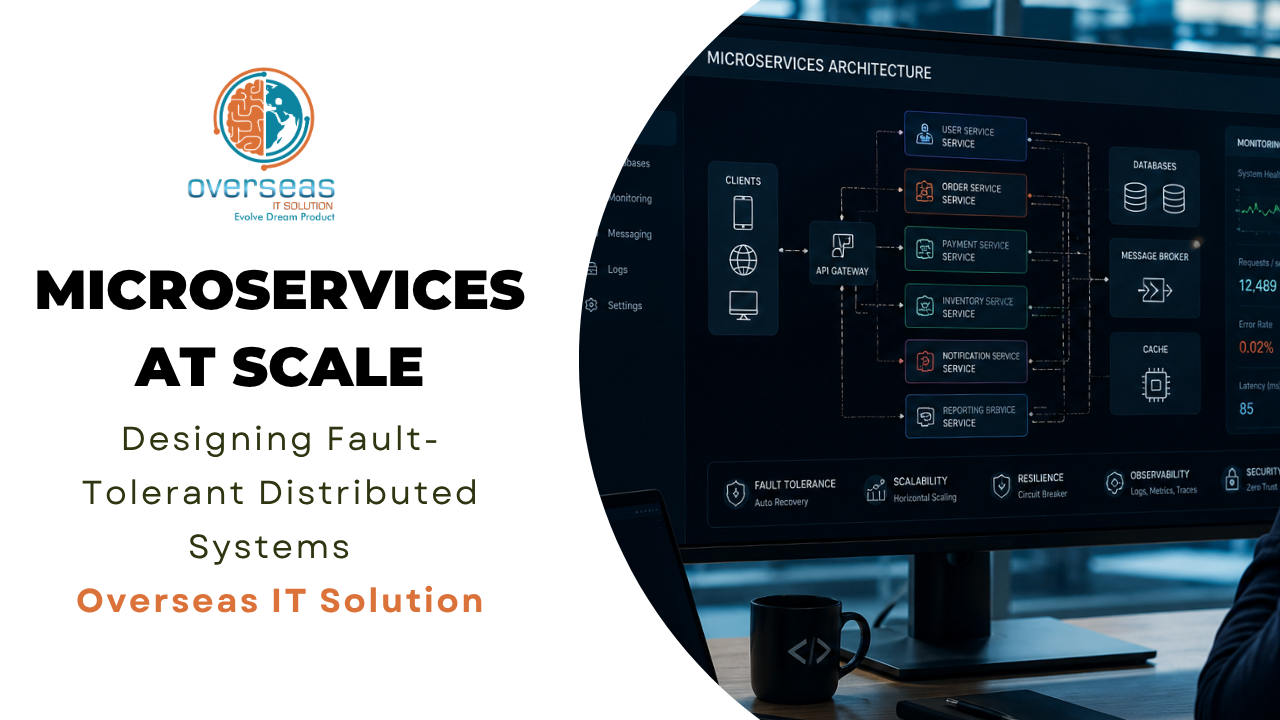
Microservices have moved from buzzword to battleground. Nearly every enterprise scaling beyond a few hundred thousand users inevitably faces the same question: how do you decompose a growing monolith without rebuilding chaos at a distributed level? The answer lies in disciplined system architecture — not just splitting services, but designing for failure, latency, and operational complexity from day zero.
Architect's Context
This article is aimed at software architects, senior engineers, and CTOs evaluating microservices strategies for SaaS platforms, ERP systems, and enterprise applications. Patterns apply across AWS, GCP, and Azure cloud-native stacks.
The Decomposition Problem: Domain-Driven Design as a Foundation
The most common failure in microservices adoption is premature decomposition. Teams split services along technical layers — separate services for 'auth', 'email', 'logging' — rather than business capabilities. This produces a distributed monolith: all the operational complexity of microservices with none of the autonomy benefits.
Domain-Driven Design (DDD) offers a principled answer. Each bounded context — a cohesive area of business logic with its own language and rules — becomes a candidate service boundary. In a veterinary clinic management platform, bounded contexts may include: Appointment Scheduling, Patient Records, Billing & Invoicing, Client Portal, and Inventory.
Core Decomposition Heuristics
Before splitting any service, evaluate it against three questions:
- Can this service be deployed independently without coordination?
- Does it own its own data — no shared database?
- Can a single team maintain it end-to-end?
If the answer to any is 'no', the boundary is premature. Revisit the bounded context definition before proceeding.
Microservices Layer Model — Architecture Overview
| Layer | Component | Responsibility |
|---|---|---|
| Edge | API Gateway | Rate Limiting, Auth, Routing, SSL Termination |
| Mesh | Istio / Linkerd | mTLS, Traffic Shaping, Retries, Observability |
| Services | Domain Services | Appointments · Billing · Records · Notifications |
| Data | Per-service DBs | PostgreSQL · MongoDB · Redis · S3 per service |
| Observability | OpenTelemetry | Distributed Tracing · Logs · Metrics |
Inter-Service Communication: Synchronous vs. Asynchronous
Choosing between REST/gRPC (synchronous) and message queues (asynchronous) is one of the highest-impact architectural decisions you'll make. Getting it wrong creates cascading failure scenarios that are extraordinarily painful to diagnose in production.
Synchronous communication — where Service A calls Service B and waits — is intuitive but brittle. If B is slow or down, A is degraded too. For queries requiring immediate responses (user login, payment validation), synchronous gRPC is appropriate. For everything else, asynchronous event-driven communication via Kafka, RabbitMQ, or AWS SQS dramatically improves resilience.
Communication Pattern Comparison
| Pattern | Latency | Coupling | Best For |
|---|---|---|---|
| REST over HTTP | Low–Medium | Tight | CRUD, simple queries |
| gRPC / Protobuf | Very Low | Tight | High-frequency internal RPC |
| Async via Kafka | Variable | Loose | Events, workflows, notifications |
| GraphQL Federation | Medium | Medium | Aggregated client-facing APIs |
| Choreography (events) | Variable | Very Loose | Saga patterns, distributed txns |
The Circuit Breaker Pattern: Designing for Partial Failure
In a microservices system with 20 services, if each service has 99.9% uptime, the compound availability of a request touching 5 services is only 99.5%. Circuit breakers — popularized by Netflix's Hystrix — prevent cascading failure by 'opening' a circuit when a downstream service fails, returning fast fallback responses instead of waiting.
Circuit Breaker States
- Closed — All requests pass through normally
- Open — All requests return a fast fallback immediately
- Half-Open — A probe request tests whether the service has recovered
Libraries like Resilience4j (Java) or Polly (.NET) implement this pattern. In service meshes like Istio, circuit breaking is configured at the infrastructure level without touching application code — a significant operational advantage.
Observability: You Cannot Fix What You Cannot See
Distributed tracing is non-negotiable in microservices. OpenTelemetry has emerged as the vendor-neutral standard — instrument once, export to Jaeger, Zipkin, Datadog, or New Relic. Every request should carry a trace ID through all service calls.
Combine tracing with structured logging (JSON logs with trace IDs injected) and Prometheus-based metrics. The 'four golden signals' — latency, traffic, errors, and saturation — should be dashboarded for every service.
Production Lesson
Never deploy a microservices system without distributed tracing in place from day one. Retrofitting observability into a running production system is one of the most difficult and dangerous operations a platform team can undertake.
Data Consistency in a Distributed World: The Saga Pattern
Distributed transactions are a solved problem — the solution is to avoid them. The Saga pattern replaces a two-phase commit with a sequence of local transactions, each publishing an event that triggers the next step. If any step fails, compensating transactions are executed in reverse.
Saga Implementation Approaches
| Approach | Visibility | Coupling | Best For |
|---|---|---|---|
| Orchestrated Saga | High (central coordinator) | Medium | Financial workflows, ERP |
| Choreographed Saga | Lower (event-based) | Very Low | Notification chains, simple flows |
| Temporal / Airflow | Excellent (workflow engine) | Low | Long-running complex sagas |
Work With Us
Overseas IT Solution specializes in building distributed SaaS platforms, ERP systems, and enterprise backends with proven architectural patterns. Contact us for a free architecture review at overseasitsolution.com
© 2026 Overseas IT Solution · overseasitsolution.com · Ahmedabad, Gujarat, India