

Category: Event-Driven Systems | Read Time: 11 min read
Event-driven architecture (EDA) is experiencing a renaissance — and for good reason. As systems grow in complexity and user expectations shift toward real-time experiences, the traditional request-response model increasingly becomes a bottleneck. Whether you’re building a cattle management platform that needs real-time herd health alerts or a financial ERP processing thousands of transactions per second, EDA provides the decoupling, durability, and scalability that synchronous systems cannot match.
Why This Matters Now
By 2026, over 60% of new enterprise applications are expected to incorporate event-driven patterns. Yet most teams that adopt Kafka do so without understanding the architectural commitments. This article closes that gap.
Events as First-Class Citizens: Designing an Event-First System
The fundamental shift in event-driven thinking is this: instead of services calling each other, they publish facts about what happened. “Order was placed”, “Payment was processed”, “Appointment was rescheduled” — these are events. Any service that cares about these facts subscribes and reacts. The publisher has no knowledge of its consumers, creating genuine decoupling.
Event Schema Design Principles
Every production event should include these mandatory fields:
event_id— UUIDv4 unique identifierevent_typewith version — e.g.,order.placed.v2timestamp— ISO 8601 UTC formataggregate_id— the entity this event relates toactor— the user or service that triggered itpayload— the event data, versioned via Schema Registry
Kafka’s Schema Registry with Avro or Protobuf enforces this contract across all producers and consumers at the infrastructure level — preventing schema drift that silently breaks consumers.
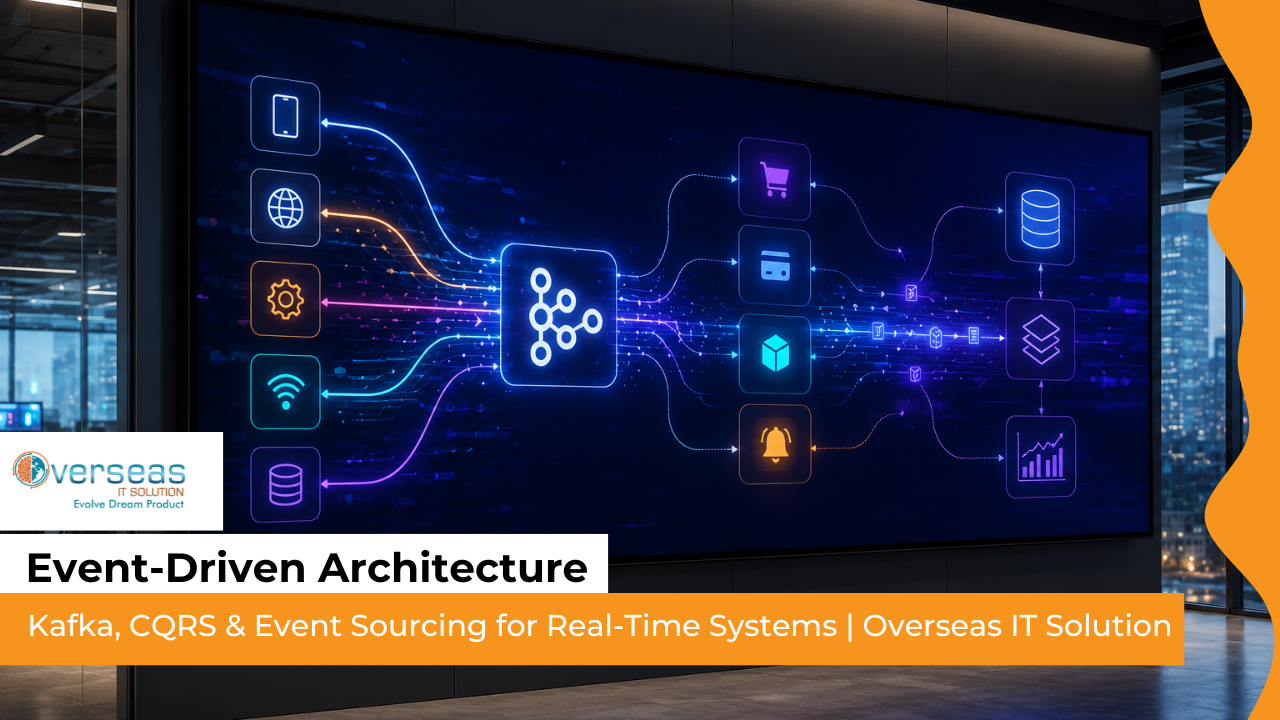
Event-Driven System Topology
| Layer | Component | Role |
|---|---|---|
| Producers | Services / IoT / Webhooks | Publish events to Kafka topics |
| Broker | Apache Kafka | Partitioned topics, replication factor 3, Schema Registry |
| Processors | Kafka Streams / Flink | Stream processing, aggregation, enrichment |
| Event Store | EventStoreDB / Postgres | Append-only durable event log |
| Read Models | Redis / Elasticsearch | Materialized views for queries |
CQRS: Separating Reads from Writes for Extreme Performance
Command Query Responsibility Segregation (CQRS) separates the write side (commands that emit events) from the read side (queries served from denormalized materialized views). This separation enables each side to be optimized independently.
Your write database can be optimized for transactional integrity (PostgreSQL). Your read databases can be optimized for query patterns: Elasticsearch for full-text search, Redis for low-latency lookups, a columnar database for analytics. Each read model is rebuilt by replaying events — a powerful capability traditional CRUD systems cannot offer.
CQRS Read Model Patterns by Query Type
| Query Type | Read Store | Update Trigger | Latency |
|---|---|---|---|
| Dashboard metrics | Redis / In-memory | Real-time event stream | < 10ms |
| Full-text search | Elasticsearch | Event consumer | < 50ms |
| Business analytics | ClickHouse / BigQuery | Batch + streaming | < 2s |
| Audit history | PostgreSQL | Event sourcing replay | < 200ms |
Event Sourcing: The Event Log as the Source of Truth
In event sourcing, you don’t store current state — you store the complete sequence of events that led to current state. The current state is derived by replaying events. This provides: complete audit history by definition, the ability to rebuild any projection, time-travel debugging, and the ability to introduce new projections retroactively.
When to Use Event Sourcing
- Business-critical aggregates with complex state transitions
- Financial accounts, order workflows, healthcare records
- Systems where audit trails are regulatory requirements
- Platforms needing the ability to retroactively add analytics
Event sourcing is NOT appropriate for simple CRUD entities with low complexity — it adds meaningful overhead without proportional benefit.
Handling Failure: Dead Letter Queues and Idempotency
In event-driven systems, consumer failure is guaranteed. The architecture must handle this gracefully through two critical patterns: Dead Letter Queues (DLQs) and idempotent consumers.
Failure Handling Pattern Matrix
| Failure Scenario | Pattern | Implementation |
|---|---|---|
| Consumer crash mid-processing | At-least-once + Idempotency | Deduplication table in DB |
| Poison pill message | Dead Letter Queue | After N retries → DLQ topic |
| Consumer lag (slow processing) | Backpressure + Scaling | More partitions + instances |
| Event ordering guarantee | Partition keying | Key by aggregate ID |
| Breaking schema change | Schema evolution (Avro) | Backward-compatible update |
Critical Architecture Decision
Always key Kafka messages by aggregate ID (e.g., order ID, user ID). This guarantees ordering within a partition for all events related to a single entity — critical for correct state reconstruction in CQRS/ES systems.
Work With Us
From cattle monitoring systems to ERP platforms, Overseas IT Solution architects event-driven solutions that scale to millions of events daily. Visit overseasitsolution.com to discuss your platform.
© 2026 Overseas IT Solution · overseasitsolution.com · Ahmedabad, Gujarat, India